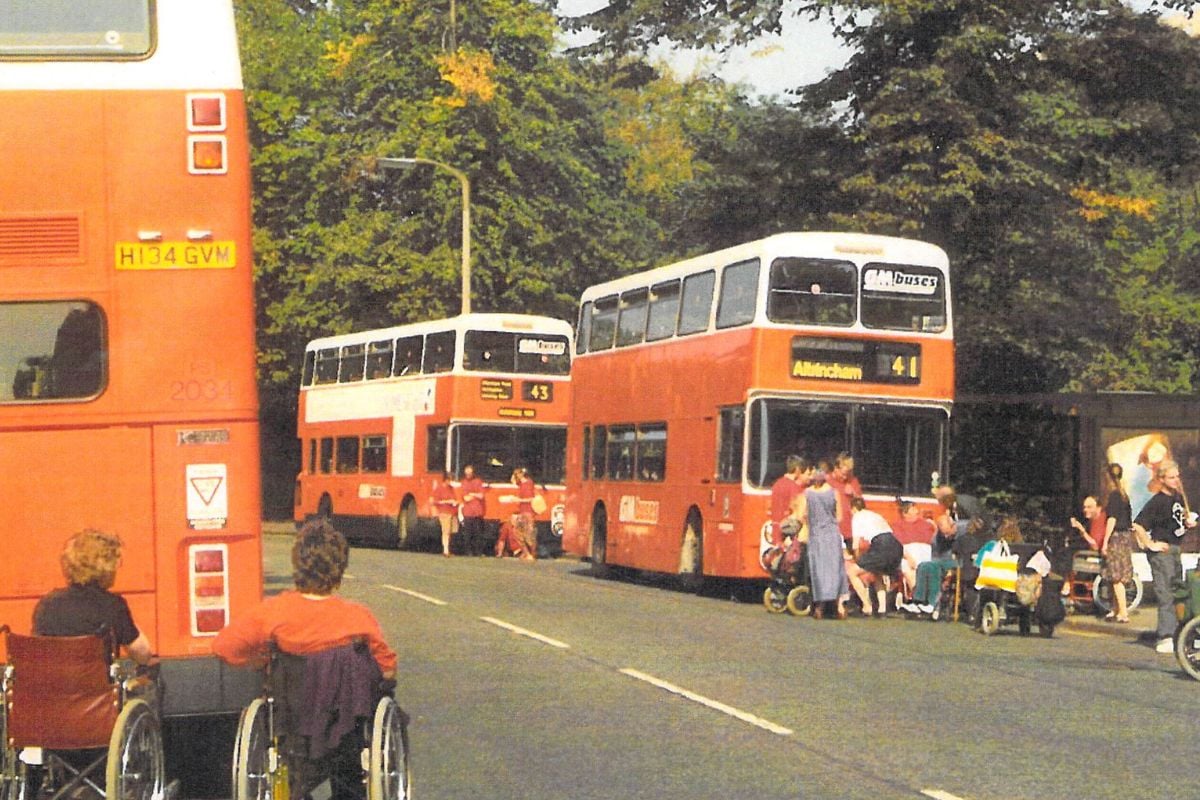
An inaccessible bus demonstration in Greater Manchester, 1991
Photo: Wikimedia Commons
Nothing Without Us: Disability in the arts and cultural sector
Dr Mai Musié, senior manager at the National Centre for Academic and Cultural Exchange (NCACE), speaks to three leaders working at the intersection of research and the cultural sector about disability history, genuinely inclusive arts, and the speed of progress.
As the final autumn leaves drop and the winter sun sets in, there is a natural inclination to pause and reflect on the passing year. 2025 has been a difficult year with major global challenges: escalating geopolitical instability; social unrest and economic uncertainty; and the growing concerns around advanced artificial intelligence, all underscored by the urgent impact of the climate crisis.
Here at NCACE we are committed to building and supporting a wide-ranging community of higher education researchers, artists, freelancers, and knowledge exchange mobilisers. From large organisations to the grassroots, we create spaces where knowledge and culture is valued and nurtured. We need collective efforts to lift voices too often sidelined.
In response to Arts Professional’s December theme of disability, I interviewed three individuals working at the intersection of research and the arts and cultural sector. David Turner is a social and cultural historian at Swansea University, specialising in disability, medicine, gender and the body. Kyle Lewis Jordan is an early-career Egyptologist and freelance curator. Jess Thom is the co-artistic director of Touretteshero, a disabled-led arts company. Their research arm explores disabled-led thinking and disabled-led knowledge.
Why disability in the arts matters
This year marks the 30th anniversary of the Disability Discrimination Act (DDA). This landmark moment created the first British legislation to protect disabled people against various forms of discrimination. It paved the way for greater inclusion, culminating in the Equality Act 2010.
David Turner said of the DDA: “I was recently involved in the Being Human Festival in November and myself and two of my PhD students, both disabled artists, organised an event in Cardiff to mark the anniversary on the date itself. We invited members of the public to come along and reflect on the act and what had achieved but also on the activism that led up to the change in the law”.
What made this public engagement event so special, David said, was that it brought together people who were involved in that campaign back in the mid-1990s: “There was someone else I met who was part of a coalition of charities and disabled people organisations called RightNow and they were involved in lobbying politicians to try and get this law through. It was just amazing to talk to her about the struggles she faced in trying to get this legislation over the line”.
The legislation itself was significant, but there were limitations, as Jess of Touretteshero affirmed. “It has not had the far-reaching change that it could have had if it was differently and widely understood and implemented. It still places a lot of emphasis on disabled people to do the labour to have the rubbish experience, then challenge it.”
Curating for change
Kyle spoke about his experience as a fellow on the jointly funded Arts Council, National Lottery Fund, and Arts Fund initiative Curating for Change. The aim of the project was to place deaf, disabled, and neurodivergent people at the “heart of researching and interpreting museum collections”. Kyle’s placement was at the Ashmolean and the Pitt Rivers Museums in Oxford.
From curating a museum display investigating disability in early societies, to co-producing a gallery trail with the disabled, the whole experience has left a profound impact on the researcher.
“Doing that job was so fulfilling to me,” Kyle explained. “It healed me. I got to show people why disabled lives matters. I got to connect with other disabled people but one of my biggest joys was when I was working at the Ashmolean, I worked with the family content producer on activities for families with disabled children because I was a disabled child once and I knew what it was like to not be represented.”
The Wellcome Trust and a radical idea
A few years ago, the Wellcome Trust announced they would take a ‘social model’ of disability approach to their collection. Jess said of the first time Touretteshero became involved with the museum: “I was clinically extremely vulnerable to Covid, and I was shielding, and so our creative outputs and partnership work had to change… we co-curated with them a series of events called ‘Feeling our Way’, which was all about disabled, neurodivergent, and chronically ill people’s experiences of touch”.
The collaboration produced different types of physical and non-physical participation and results, including a piece of audio from two blind creatives who shared their experiences of touch as they navigated a museum.
“That intersection of how art, knowledge, and experience come together in a physical space and digital space, felt very exciting,” Jess said.
Slow progress
Even among positive collaborations there are challenges. Reflecting on his placement experience with Curating for Change, Kyle said “there are definitely times where you run up against expectations or pressures.”
“I really struggled,” he said. “In a museum where there is departmental breakdown, curators can be very protective of their spaces. There was lot of reticence about just allowing me to go in and do something.”
He has found accessing full-time employment in the sector post-placement very difficult. On top of the low pay, the request for three-year minimum sector experience, and the traditional complex application processes can all be major hurdles to overcome.
For Jess, progress in the sector is frustratingly slow. Organisations are more worried about perceived reputational harm than inaction.
“The risk of that is that we are missing out on perspectives, knowledge, and stories that will strengthen our areas of study and interest,” Jess said.
This speaks to a wider challenge, whereby people are disabled by policy, and the systems that should be working for them. David, Jess, and Kyle all expressed their frustration and dismay around the lack of progress on financial support for disabled people, particularly on Personal Independence Payment and the Access to Work scheme.
Both Kyle and Jess benefited enormously through the Access to Work scheme, which supported transport and accommodation costs and made full-time working life possible.
But cuts to support made in meant that Jess had to stop working until it was re-instated. “I work in an industry that plans between 18 months and two years in advance [of projects], but I only know I have support for a matter of months. That is not giving me the stability that I need to thrive.”
What can the sector learn?
Clearly, the sector must know more about disability history and grow more comfortable around disability. Anti-ableist training or disability equality training may help break down people’s misconceptions and internalised bias.
David said: “A lot of people I encounter worry about saying the wrong thing. They want to be inclusive, they don’t like the idea that disabled people are excluded from these spaces, but they don’t really know what to do or are worried that they might offend somebody.”
A part to play: celebration and awareness
Ultimately, the sector holds the key to both celebrating disabled people’s lives and illuminating their experiences.
As David said: “The arts has a real, crucial role to play in raising awareness but also in helping to celebrate the wonderful and creative work that disabled people produce.”
Join the Discussion
You must be logged in to post a comment.